.webp)
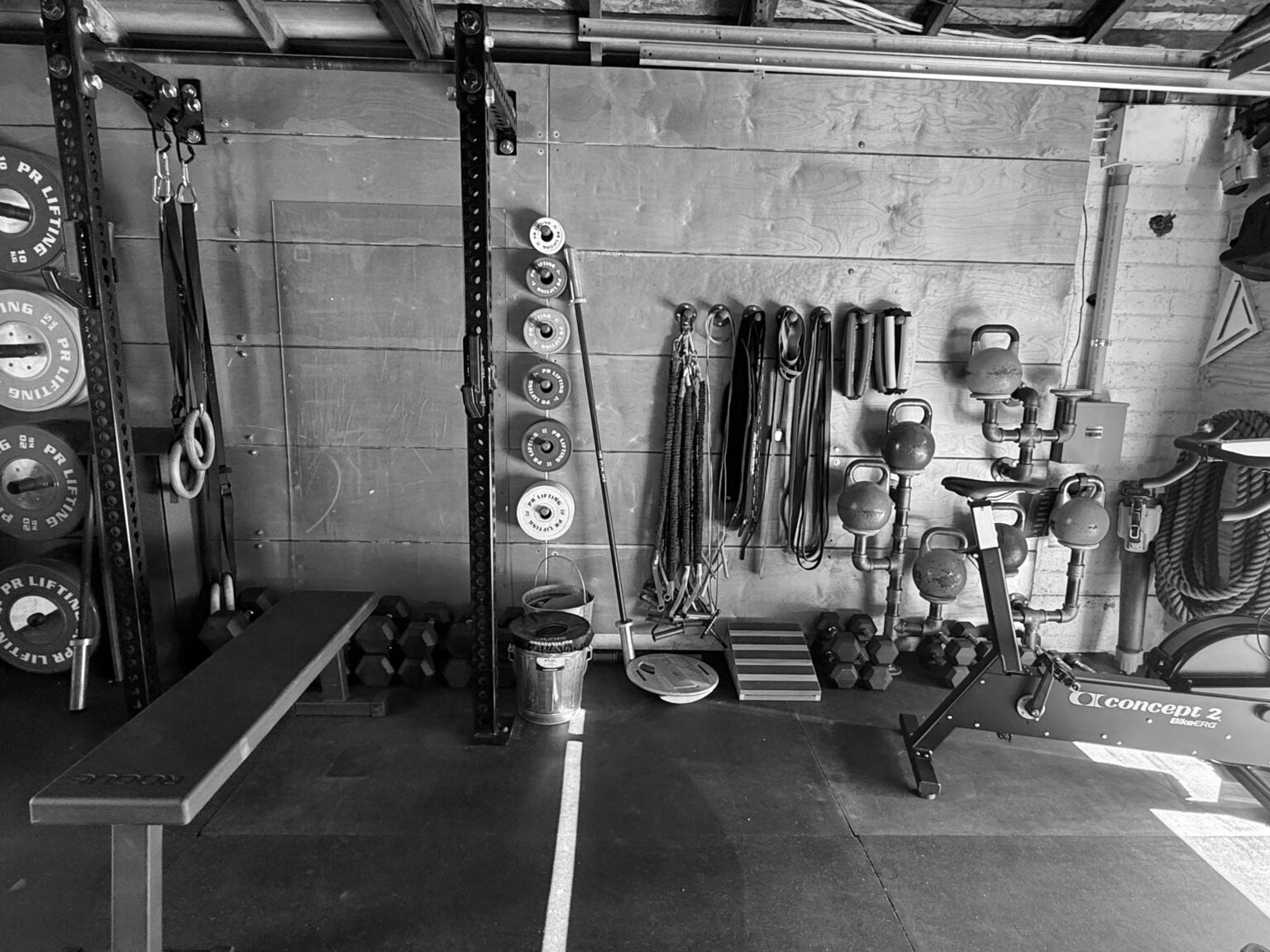
I spent the holiday weekend deep in the sacred ritual of garage transformation. The goal? Turn our clutter-cave into a functioning home gym and office—a barbell‑centric zen garden, if you will. Unfortunately, “stick everything that doesn’t have a home into the garage” is a terrible interior design strategy. So we broke out all the saws. Built shelving. Installed an accent wall (because we’re not barbarians). And added an adorable shed out front for the bigger toys.
Did the shed need a shingled roof? No. Did it get a shingled roof? Absolutely. That meant a coil roofing nailer, a paint sprayer, and a few more receipts than I care to admit. It was time‑consuming, unnecessarily expensive, mildly chaotic—and I love the end product so effing much. Every time I look at the shed, it makes me smile. Every time I walk into the garage now, I feel calm. Focused. Ready. And that’s the point. Sometimes you don’t just need motivation. You need space. Literal space. Emotional space. Purposeful space.
We didn’t just need a place to store camping gear and kettlebells—we needed a place where training could happen without distraction. A space where work feels intentional. A space that invites you to show up as the version of yourself you’re trying to become. We often say, “Just start.” And it’s mostly true. But sometimes, the most important thing is to make room. Physically. Mentally. Emotionally. Because life is hard enough without your goals having to fight through piles of clutter and chaos to reach you. If you’ve been struggling to make fitness or wellness part of your rhythm, maybe what you need isn’t more discipline. Maybe it’s just a little more space. At RESET, we’ve already made that space for you. Now you just have to step into it.
As Jordan Holland, I write and coach from one of our five core pillars—Healthspan Focus (formerly: good movement/pliability + balance + eat real food—nervous system is a huge part of this). In plain terms: I want you to live a long time and to keep your freedom of movement the whole way. Healthspan beats lifespan if lifespan arrives without the ability to squat to the ground, carry groceries, climb stairs, or get up off the floor without choreography. The pillar weaves through everything we do at RESET, from how we design training sessions to how we design rooms.
“Discipline is easier in a room designed for it.” — Jordan
Why Space Matters to Healthspan
Behavior scientists have been telling us for years that environment beats willpower. James Clear calls it “environment design”: set up your space so the right action is the easy action. BJ Fogg says behavior = motivation × ability × prompt; change any of the three, the behavior changes. A gym bag that lives by the door, a barbell on a ready rack, a kettlebell by the coffee maker—those aren’t decorations; they’re prompts.
This isn’t just psychology; it’s neurology. Your nervous system is constantly sampling the world to decide whether you can rest-and-digest or need to fight-or-flight. Visual clutter, competing noises, endless notifications—these all keep you on the sympathetic side of the seesaw. Cal Newport (author of Deep Work) argues that attention is our scarcest asset; the cost of context‑switching is performance. When your training space is clean and your phone is on airplane mode, your nervous system can actually downshift, skill learning sticks, and you press better, hinge better, breathe better. Healthspan lives in those small, repeatable wins.
I’m not the only one obsessed with future capability. Peter Attia talks about the “Centenarian Olympics”: train today for the tasks you want to do at 100—carry luggage, lift a kid, get off the ground with grace. Greg Glassman gave the simplest nutrition and movement prescription I know: eat quality foods, keep intake to support exercise not body fat, and train broadly. Kelly Starrett (co‑author of Built to Move) reminds us that position is power; better positions mean more leverage today and fewer orthopedic bills tomorrow. If Healthspan Focus is the headline, those thinkers are the subheads.
The Nervous System Thread
Healthspan isn’t only joints and muscles. It’s the nervous system’s ability to toggle between arousal and recovery. A tidy training nook can lower cognitive load before a single rep. Light a small ritual fuse—two minutes of nasal breathing, a quick mobility flow, one song of easy rowing—and your vagus nerve gets the memo: it’s safe to train. Afterward, a five‑minute downshift (legs up, slow exhales, a short walk outside) tells the same system we’re finished here, thanks for playing. That dance between sympathetic and parasympathetic is the hidden engine of consistency.
A Tale of Two Garages
Before the overhaul, I would wander into the garage at 6:20 a.m., trip over a box of Halloween stuff, and spend seven minutes looking for a clip. By the time I found the right plates, my first meeting was looming. I’d rush the warm‑up, skip the last set, and tell myself I’d make it up tomorrow. (Reader, I did not.)
After we rebuilt the space, the bar sits on a ready rack, clips are on the post, kettlebells are visible, jump rope’s on a hook, and the timer is already on the shelf. Ten minutes faster to first rep, ten minutes safer in the warm‑up, and—most important—ten times more likely I actually finish what I start. Healthspan hides in those frictions you remove.
How to Build a Healthspan Space (Home or Gym)
- Define your mission. What are the next three capacities you want to own? Deep squat to the floor? Ten strict push‑ups? A 10‑minute farmer’s carry without setting the bells down? Write them on the wall. Oliver Burkeman calls these “finitely game‑able” goals—the kind that focus attention.
- Audit friction. What slows you down in the first five minutes? Missing clips? Dead jump rope? Random boxes? Solve the top three today. That’s Nudge theory (Thaler & Sunstein): change the choice architecture, change the choice.
- Light the ritual fuse. Two minutes of breathwork, five hip circles, one set of goblet squats. Same sequence every day. Andrew Huberman will tell you: predictable rituals are dopaminergic—they prime you to want to start.
- Make recovery visible. Leave the foam roller where you actually stretch. Keep the magnesium or protein where you actually eat. Put your walking shoes by the door you exit.
- Guard attention. Put your phone on airplane, or better, in the other room. Cal Newport again: depth requires a barrier to shallow.
- Design for delight. My accent wall? Unnecessary. Also effective. If the room makes you smile, you’ll show up more. As Austin Kleon says in Keep Going, make it a bliss station.
Yes, This Is Also About Food
Our pillar used to read “good movement/pliability + balance + eat real food.” That last line is the silent partner in your space. A tidy fridge is a training tool. Put cooked protein at eye level. Pre‑wash greens. Chop peppers into grab‑handles. Put the sparkling water where the soda used to live. Shakespeare didn’t say “the fridge is destiny,” but he could have.
The gut‑brain loop is real: a diverse, fiber‑fed microbiome supports steadier mood, better immune function, and sharper cognition. That looks like 30+ different plant foods per week, fermented staples if you tolerate them, adequate protein, and minimal ultra‑processed fillers. You don’t need to be perfect; you do need to be consistent. Consistency is a systems problem, not a character flaw. Systems live in rooms.
A Quick Word on Identity (and Pants)
If you’ve ever delayed buying bigger pants because “this is a blip,” I see you. Suddenly a year passes, the pants are still tight, and your inner monologue has learned a new avoidance dance. I’ve been there. The way out for me was simple, not easy: treat food logging and meal prep like a heavy set—uncomfortable, finite, and worth it. Once I had a reliable system, weight trended down, training trended up, confidence trended back. Healthspan: 1, Avoidance: 0.
Community Is a Space, Too
We talk about rooms, but the most powerful space is people. A coaching cue delivered at the right second, a fist bump after your last rep, a small laugh when you miss, a bigger laugh when you nail it—those are architecture. Simon Sinek calls it the circle of safety. Adam Grant will remind you that cultures are built from the stories groups tell about what’s normal. At RESET we tell the same story, over and over: Show up. Be kind. Do hard things. Recover well. Repeat.
That’s why, when someone asks me which San Diego gym to join, I say: find the room where your future self already hangs out. If you want a place that blends coaching, community, and systems designed for your nervous system, come see why RESET CrossFit has a claim on the best gym in San Diego conversation. We say it twice because we mean it: we want to be the best gym in San Diego for people who care about healthspan.
Your 7‑Day Space Sprint
- Day 1 – Name it. Write two sentences that define your healthspan goals for the next 90 days. Stick them on the wall.
- Day 2 – Clear it. Remove five items that don’t belong in your training zone. Trash, donate, or relocate.
- Day 3 – Stage it. Set up the first five minutes: timer, water, warm‑up tool, primary implement, music.
- Day 4 – Stock it. Prep two proteins, chop three vegetables, wash a salad base. Put them at eye level.
- Day 5 – Ritualize it. Choose a 3‑minute pre‑training ritual and a 3‑minute post‑training downshift. Repeat exactly.
- Day 6 – Protect it. Create a phone‑free window for training. Tell someone who will hold you to it.
- Day 7 – Celebrate it. Take a photo of your space. Track one small PR. Share a win with a friend.
The Quiet Payoff
Here’s what happens when you build space first: you start more sessions, finish more sessions, and recover from more sessions. You cook more meals at home. You sleep a little better. You feel less rushed and more intentional. The nervous system learns the pattern: this room equals progress. And progress, even tiny daily progress, compounds.
I renovated a garage and accidentally renovated my training consistency. The accent wall still makes me happy. The shed roof still makes no financial sense. But the space earned its keep on the first weekday morning I walked in and didn’t have to hunt for a clip.
If any part of your body, routine, or calendar feels like it needs a reset (see what I did there), start with a room. Then add a ritual. Then add a rep. The motivation will catch up to the momentum.
I’ll end where I started: you don’t always need more motivation; sometimes you need more room. Design the room, and you’ll find the discipline waiting for you. That’s Healthspan Focus. That’s the nervous system doing what it does best when we give it a fair shot. And that’s the next version of you, already moving better, feeling better, and showing up—because the space is set.
Sources & further reading
Ultra-processed foods & health outcomes
- Hall, K. D., et al. Randomized inpatient trial showing ultra-processed diets drive higher calorie intake and weight gain. Cell Metabolism (2019). PubMed
- Rico-Campà, A., et al. Higher UPF intake linked to a 62% higher hazard of all-cause mortality in a Spanish cohort. BMJ (2019). BMJPMC
- Beslay, M., et al. UPF consumption associated with weight gain and higher risks of overweight/obesity. PLOS Medicine (2020). PLOS
Gut health, mood/cognition & serotonin
- Margolis, K. G., et al. Review of the microbiota-gut-brain axis from “motility to mood.” (Open-access). (2021). PMC
- Li, M., et al. Review on gut dysbiosis, metabolic disease, and mechanisms (SCFAs, bile acids). Signal Transduction and Targeted Therapy (2022). Nature
- Nature review: ~90% of the body’s serotonin is produced in the gut; overview of gut-derived metabolites and signaling. (2024). Nature
Diet diversity & the microbiome
- McDonald, D., et al. The American Gut Project: greater plant diversity (e.g., ~30+ types/week) associates with higher microbial diversity. mSystems (2018). ASM Journals
Protein, appetite & breakfast
- Gwin, J. A., & Leidy, H. J. High-protein breakfast improved appetite/satiety and reduced evening snacking vs. skipping breakfast. Current Developments in Nutrition (2018). PMC
Muscle loss with aging / women’s midlife changes
- Cruz-Jentoft, A. J., et al. Revised European consensus on sarcopenia (rates of age-related muscle loss; assessment/management). Age and Ageing (2019). PubMed
- Greendale, G. A., et al. SWAN cohort: body-composition shifts across the menopause transition. JCI Insight (2019). JCI Insight
Short-chain fatty acids (SCFAs) & metabolic health
- Silva, Y. P., et al. SCFAs as key microbiota-derived metabolites influencing gut-brain and metabolic pathways. Frontiers in Endocrinology (2020). Frontiers
- Pham, N. H. T., et al. Systematic review on SCFAs and insulin sensitivity. Nutrition Reviews (2024). Oxford Academic
Behavior & environment design (habit formation, focus, longevity)
- James Clear — Atomic Habits (official site). James Clear
- BJ Fogg — Tiny Habits (book site). Tiny Habits
- Cal Newport — Deep Work (book page). Cal Newport
- Peter Attia — Outlive (official book page). Peter Attia
- Kelly Starrett & Juliet Starrett — Built to Move (The Ready State). The Ready State
- Thaler & Sunstein — Nudge: The Final Edition (Penguin/PRH page). Penguin Random HousePenguinRandomhouse.com
- Austin Kleon — Keep Going (author page). Austin Kleon
- Oliver Burkeman — Four Thousand Weeks (author page). Oliver Burkeman