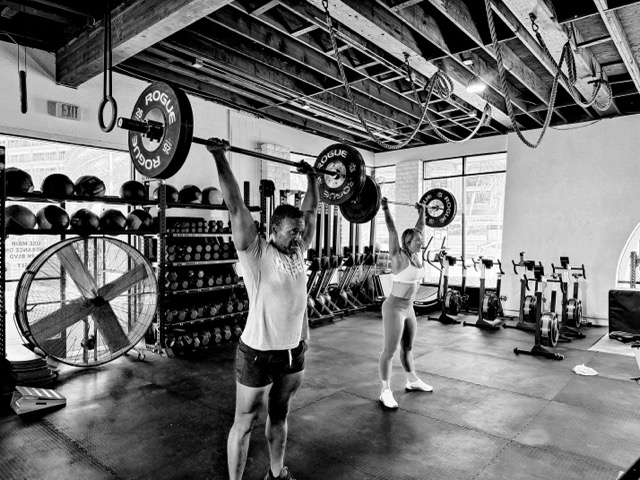
Every Monday at 10 a.m., I have a standing date with a married woman. My wife knows. She's completely supportive. Honestly, everyone involved seems remarkably comfortable with the arrangement. Yesterday, her husband even stopped by in the middle of it to bring snacks. If this is a scandal, we're doing a spectacularly poor job of keeping it secret.
Like these things often do, it started innocently enough. A little physical activity. Some casual conversation. Before long there was a genuine connection. We talk about life, the important stuff and the hard stuff, between bouts of doing things most reasonable adults would pay good money to avoid. She's a beautiful human being, and I'm grateful to have her in my life. Her name is Coach Ashleigh, and our weekly rendezvous involves lifting heavy things followed by a metcon that makes me question whether this relationship is healthy. Snatching. Squatting. Sweating. Occasionally staring at the floor and reconsidering the decisions that brought me here. Every Monday. It's wonderful and awful. Mostly wonderful.
The training itself has gotten better because of her. I've improved as a lifter simply by showing up consistently and having someone to work alongside. And when the conditioning starts, I push harder than I probably would alone. Not because she screams at me or because we have some elaborate competition with a leaderboard and a cash prize. I just don't want to be the first one to quit. Unfortunately, Ashleigh seems entirely uninterested in quitting, which makes her a terrific training partner and, on certain Mondays, an exhausting person to know.
But the real magic isn't the weight on the bar or the pace on the bike. It's the conversation before we start, the ridiculous comments made between sets, the quiet understanding that neither of us needs to explain why we're there. Some weeks we talk about big things. Some weeks we talk about nothing particularly important. Sometimes communication is reduced to eye contact and utterances usually associated with vocalizations of injured livestock. All of it counts. I look forward to the person as much as the workout, which is saying something because I really like lifting heavy things.
This is an aspect of fitness that gets lost when we reduce exercise to calorie expenditure, muscle growth, and cardiovascular adaptations. Those things matter. They're a big part of why RESET exists. But human beings aren't collections of body parts being optimized independently. We're social animals, and most of us do better when there's somebody who notices whether we show up. Somebody who knows what we're capable of, recognizes when we're having an off day, and celebrates a win that wouldn't mean much to anyone else. An extra five pounds on a clean is not headline news. To the person who watched you struggle with that weight for months, it can be the most exciting thing that happens all morning.
There's actual science behind this, and not the sort that requires me to claim our workouts trigger a mysterious hormone that turns strangers into lifelong friends. Psychologist Richard Ryan and his colleagues have spent decades developing self-determination theory, which describes three basic psychological needs: autonomy, competence, and relatedness. We want to have a say in what we do, feel capable of getting better at it, and feel connected to other people. A 2012 systematic review led by Pedro Teixeira found that more self-directed forms of motivation were consistently associated with exercise participation, with enjoyment especially relevant to sticking with exercise over time. A good gym can support all three needs. You choose to be there, you see yourself improve, and you find people worth coming back for. Teixeira et al., 2012.
That last part is easy to dismiss as a nice bonus, like the music or the fact that somebody remembered your dog's name. It isn't. Psychologist Julianne Holt-Lunstad and colleagues analyzed 148 studies involving more than 300,000 people and found that stronger social relationships were associated with 50 percent greater odds of survival over the periods studied. That's an association, not proof that making friends at CrossFit adds a specific number of years to your life. But it's a powerful reminder that relationships belong in the same conversation as the other things we do for our health. Holt-Lunstad et al., 2010.
And then there's the wonderfully strange fact that doing something difficult together can bring people closer. In experiments published in Psychological Science, Brock Bastian and colleagues had strangers complete unpleasant tasks, including putting their hands in painfully cold water and holding uncomfortable positions. Participants who shared the unpleasant experience reported stronger feelings of bonding and, in related experiments, behaved more cooperatively than those who didn't. The findings don't mean suffering is inherently noble or that coaches should start filling the gym with buckets of ice water. Although at RESET we have a separate room for that. They suggest that a manageable, shared challenge can sometimes help turn a collection of individuals into a group. Bastian et al., 2014.
Anyone who's finished a hard CrossFit workout next to a friend already has a less scientific description: misery loves company. There is a particular intimacy in looking across the room at someone who is just as wrecked as you are and realizing you both voluntarily signed up for this. Nobody was drafted. Nobody was tricked. We saw the workout written on the board, recognized exactly how unpleasant it would be, and decided to participate anyway. Then, astonishingly, we high-fived afterward and made plans to do it again. If a sociologist from another planet observed this ritual, I'm not sure the conclusion would be that ours is an intelligent species.
But here's the part that matters most to me. We get to choose. We choose whether to train, how hard to push, what movements are appropriate for our bodies, and who we want beside us. We have coaches who can modify a workout if an injury or limitation requires it. We can stop when stopping is the right decision. The discomfort is voluntary, bounded, and undertaken in service of something we value. That is an extraordinary privilege, and it's easy to forget when you're staring at an assault bike wondering whether your lungs have filed a formal complaint.
So many people don't get that choice. Hardship shows up in their lives uninvited through illness, grief, financial insecurity, caregiving, and circumstances they never would have selected. I'm not comparing a Monday metcon to those experiences. They're not remotely the same. What I'm saying is that having the freedom to practice doing hard things, surrounded by people who care about us, is worth appreciating. The gym lets us meet discomfort on our own terms. Outside the gym, life is rarely so considerate.
This is why I'm skeptical of the idea that fitness has to be a solitary act of discipline. Yes, you can get extraordinarily fit training alone. Some people prefer it. But for those of us who thrive around other people, the social connection isn't a distraction from the work. It's part of what makes the work sustainable. You show up for the workout, but sometimes you stay for the conversation. You schedule a class because a friend will be there. You return after an absence because someone noticed you were gone without making you feel guilty about it. Little by little, the place becomes more than a place where you exercise.
I see this at RESET all the time. People arrive with goals about losing weight, getting stronger, or figuring out whether this fitness lifestyle is for them. Those goals are real, and we're serious about helping people accomplish them. But somewhere along the way, names turn into friendships. A person who initially came in nervous about keeping up starts checking on a newer member. People make plans outside the gym. They show up for community service, celebrate birthdays, and help each other through seasons that have absolutely nothing to do with fitness. The gym becomes a point of connection in a world where genuine connection can be surprisingly hard to find.
I don't want to oversell it. Not every training partner needs to become your best friend. Not every workout needs to produce an emotional breakthrough. Some Mondays we're just lifting weights and making terrible jokes. That's enough. Friendship isn't built only in life-changing conversations. More often it's built through repetition: being in the same place, at the same time, doing something together, week after week. Somewhere between the warm-up and the last miserable interval, trust sneaks in without asking permission.
Tomorrow, there will be plenty of things I can't control. There always are. But Monday at ten is on the calendar, and unless life intervenes, I'll be there. I'll get to lift something heavy, learn something, laugh about something inappropriate, and suffer a little beside someone I'm lucky to know. Then we'll go back to our actual lives, hopefully stronger and almost certainly sweatier than when we arrived.
Find your people. Do hard things together. Appreciate the hell out of both. And if you're lucky enough to have a standing Monday morning date that involves a barbell, a little emotional intimacy, and the occasional desire to vomit, don't take it for granted. Especially when her husband brings snacks.