.webp)
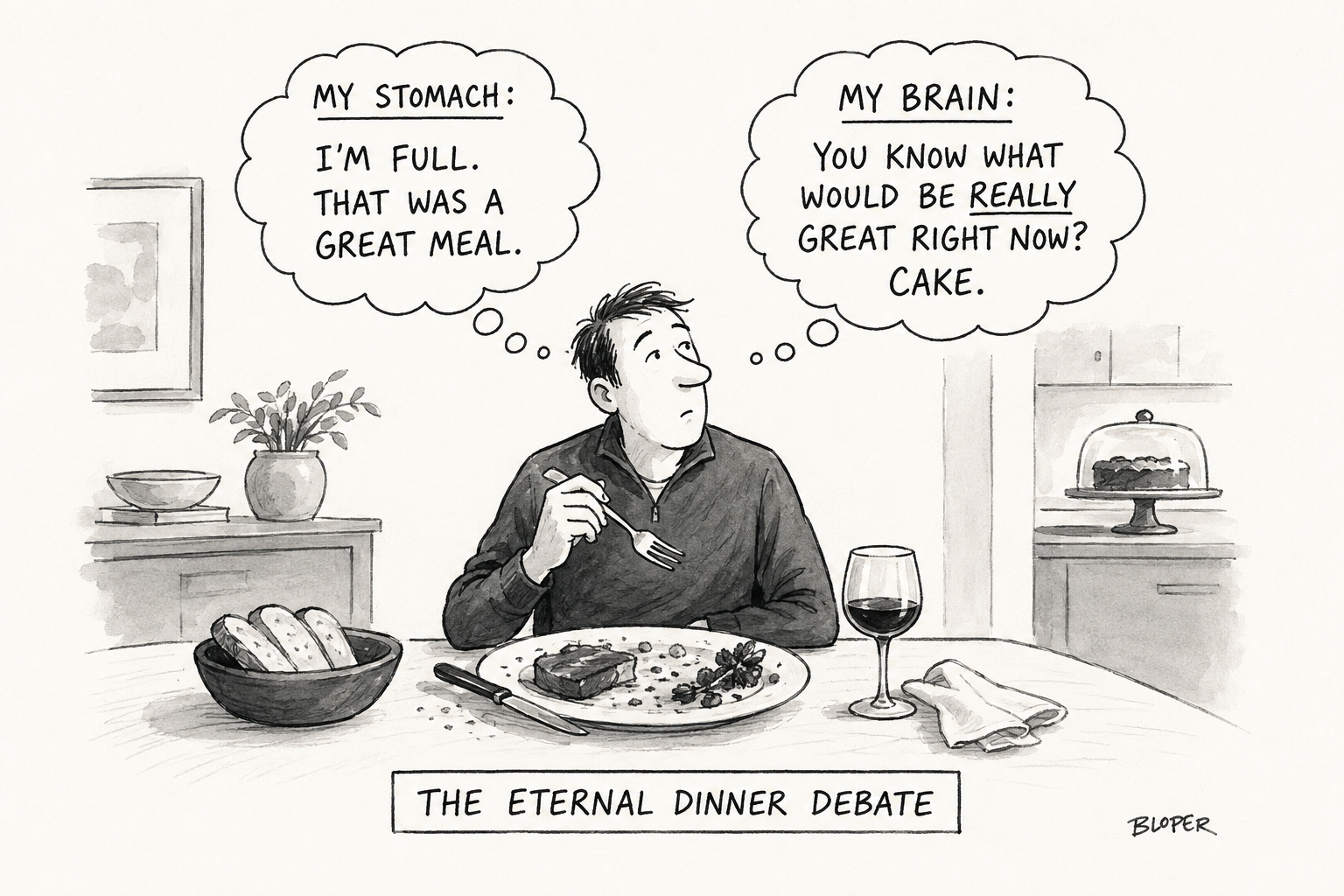
I was chatting with someone recently about the difference between physiological and psychological satiety. In normal-person language: the difference between being full and feeling satisfied. These sound like they should be the same thing. They are not.
We’ve all had an incredible meal where we keep eating despite reaching a state of mild respiratory distress. The food is just so good. One more bite. Then one more. Eventually you push the plate away with great ceremony because you are DONE. Two minutes later you're nibbling again. You were excited about leftovers, but now there isn't really enough to warrant a box, so suddenly finishing everything becomes an act of environmental stewardship. Think of the plastic. Think of the planet. Think of the starving children in Africa. At this point, eating the remaining mashed potatoes is basically humanitarian work. Your body was full 20 minutes ago. Your brain had other plans.
Then there’s the opposite experience. You eat a delicious and nutritious dinner. Plenty of protein. Vegetables. Appropriate portions. Maybe even some whole grains because you are a person of extraordinary virtue. Your stomach reports that all systems are full, but something remains cosmically unresolved. A little piece of cake would set the world right. Then perhaps something salty. Then maybe a tiny sweet thing to close out the salty thing. There is a term for that feeling: mismatch potential. My wife tells me that she permanently suffers from this affliction and there is no known cure.
This is one of the more interesting challenges that shows up when people start trying to improve their nutrition. We tend to talk about eating as though there are two settings: hungry and full. Eat when hungry. Stop when full. Congratulations, we have solved nutrition and can all go home. Except humans are considerably more complicated than that.
Sometimes we eat because we're hungry. Sometimes because food is delicious. Sometimes because we're bored, stressed, celebrating, or everyone else is eating. Sometimes because the chips are sitting six inches from our hand, and apparently six inches is the precise distance at which a tortilla chip becomes irresistible. And sometimes we keep eating because although our stomach is full, the meal didn't give our brain the experience it was looking for.
There is nothing inherently wrong with eating because something tastes amazing. Food is not merely gasoline for your human machine. Food is culture and celebration and memory and pleasure. Some of my favorite moments with people I love have happened around a table. I have absolutely eaten past fullness because Kev made something incredible, and if that is how I eventually meet my maker, please tell everyone I died doing what I loved.
But if you're trying to change your body composition, improve your health, or simply develop a better relationship with food, it helps to understand why you're eating when you're eating. Imagine you've finished dinner and immediately start thinking about dessert. Instead of declaring yourself weak, undisciplined, addicted to sugar, or whatever dramatic diagnosis Instagram has given you this week, get curious. Am I actually hungry? Would I eat another chicken breast right now? Would some fruit sound good? Or am I specifically hungry for the chocolate cake sitting in the refrigerator?
Those are different signals, and recognizing the difference doesn't mean you can't have the cake. Sometimes the correct answer is, "No, I am absolutely not hungry, but that cake is fucking delicious and I would like some." Great. Have some cake. The point isn't to eliminate pleasure. The point is to stop operating on autopilot.
This is where weighing, measuring, tracking, meal planning, and some of the other decidedly unsexy tools of nutrition can be useful. Not necessarily forever. They help us collect information. You begin noticing that certain meals keep you satisfied for hours while others have you digging through the pantry 45 minutes later. You learn that a plate with plenty of protein, vegetables, fiber, and enough actual food behaves very differently in your body than 700 calories of something engineered to disappear effortlessly into your mouth.
You also start learning your own patterns. Maybe 8:48 p.m. is your witching hour. Mine certainly can be. Dinner was great. Calories are appropriate. Protein target achieved. I am absolutely not hungry. And yet suddenly popcorn seems less like a snack and more like my destiny. Next thing I know I've made a laundry hamper full of it and I'm settling in like a pioneer preparing for winter. Knowing that pattern exists gives me choices, and that's the useful part.
Because nutrition isn't ultimately about creating a perfect diet. It's about developing enough awareness that your choices increasingly line up with the life you're trying to build. At RESET, we talk a lot about eating real food: meat, fish, eggs, vegetables, fruit, rice, potatoes, beans. Things that generally resemble what they were before becoming dinner. Not because processed food is evil or because eating a Pop-Tart will cause your rectum to prolapse, but because real food tends to make many of the important parts of nutrition easier. Protein gets easier. Fiber gets easier. Micronutrients get easier. Managing hunger often gets easier. And when the basics get easier, consistency gets easier.
You don't need to win every interaction with food. You don't need to leave Thanksgiving dinner at precisely 7.3 out of 10 fullness or hit up a methadone clinic over sleeve of Oreos. You just need to become a little more aware. There is enormous power in being able to pause and ask: What am I actually looking for right now? Food? Pleasure? Comfort? A break? A reward? Or perhaps just a piece of cake because cake is wonderful?
Sometimes the answer will be broccoli. Sometimes the answer will be cake. The goal is to know which conversation you're having.
And if you're trying to figure all of this out and it feels considerably more complicated than "eat less, move more," that's because it is. Humans are messy. Food is emotional. Habits run deep. You don't have to untangle all of it today. Start by noticing the difference between full and satisfied. That little bit of awareness might change more than you think.